Sudoku
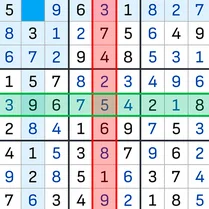
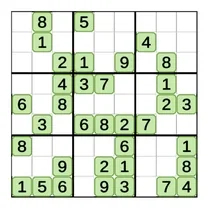
Sudoku is a timeless brain teaser built around a simple yet endlessly engaging rule: fill a nine-by-nine grid so that every row, column, and three-by-three box contains the digits 1 through 9 exactly once. The initial clues may be few or many, depending on the difficulty you choose, but the core goal never changes. Each puzzle is a logic trap waiting to be sprung, with no arithmetic involved—just careful deduction and pattern recognition. The game provides a clean, distraction-free interface for focusing on the mental challenge. You can pick from different starting levels, get subtle hints when you're stuck, and check your progress for errors. A built-in timer tracks your solving time, letting you measure improvement over multiple sessions. Whether you have a few spare minutes or plan an extended mental workout, its straightforward controls and adjustable pacing make it a satisfying companion for both newcomers and seasoned number-crunchers.
 WaffleMath
Common Core State Standards
Every game supports specific Common Core standards. Browse the full standards library.
Practice by Skill
Games by Grade
What is Sudoku
Pick a difficulty and dive into a grid that may look simple at first but rewards every bit of your logical thinking. Sudoku is all about spotting the right number for each empty cell without guesswork.
How to Play
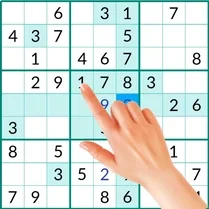
Tap or click an empty cell and select any digit from 1 to 9 to place it. Use pencil marks to note potential candidates for a cell, and switch between easy, medium, and hard to match your mood.
Tips for Playing
- Start by scanning rows and columns to find cells where only one number can fit.
- Use pencil marks to list all possible candidates for each cell and narrow them down gradually.
- Focus on one number at a time, checking each 3x3 box for missing digits.
- When completely stuck, check each row, column, and box for hidden singles or pairs.
- Take a short break if you hit a wall—fresh eyes often spot what you missed.
Frequently Asked Questions
Is Sudoku more about math or logic?
It is purely logical. No arithmetic is required; you simply need to follow the placement rules and deduce which digits fit where.
How many difficulty levels are there?
There are three main levels: easy, medium, and hard. The difficulty affects the number of starting clues and the complexity of the logic needed to solve it.
Can I undo a mistake after placing a number?
Yes, you can undo your last move using the undo button, which is helpful if you accidentally place a wrong digit or change your mind.
How does the hint feature work?
If you're stuck, the hint button reveals a correct number in an empty cell without penalizing your score, allowing you to continue smoothly.
Is there a time limit for solving a puzzle?
No strict time limit exists; the timer simply records how long you take. You can play at your own pace and restart or try a different grid as you like.
What happens if I fill a cell with the wrong number?
The game can highlight errors if you enable error checking, making it easy to spot mistakes and correct them before finishing the puzzle.