Thirteen Solitaire
Thirteen Solitaire reimagines the traditional card-clearing genre with a simple yet brain-teasing premise: every card you remove must be matched with another so their combined face value equals 13. This rule turns the entire tableau into a puzzle of careful selection, where an impulsive move can leave you stuck with unmatched cards. The game strips away complex mechanics, letting you focus purely on logic and observation, making each session a calm but engaging mental workout. What sets this version apart is the way it escalates. As the tableau thins out, each remaining card becomes a decision point, and the margin for error shrinks. You'll often find yourself tracing chains of possibilities backward, trying to spot a path that clears everything. Whether you're a casual player seeking a quiet distraction or a puzzle enthusiast looking for a compact challenge, Thirteen Solitaire delivers a satisfying mix of strategy and chance—all from a single deck.
 WaffleMath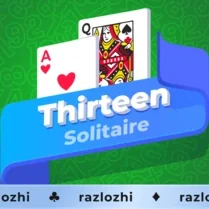
Common Core State Standards
Every game supports specific Common Core standards. Browse the full standards library.
Practice by Skill
Games by Grade
What is Thirteen Solitaire
Put your card-savvy to the test in this numeric twist on solitaire. Pair up cards that total 13 to wipe the board and claim victory.
How to Play
Click a card to select it, then click another card whose value, when added to the first, equals 13 (e.g., 6+7 or King+Ace). Clear the entire tableau while tracking rank values for face cards to succeed.
Tips for Playing
- Always scan the board for immediate high-value matches like Kings with Aces before committing to other pairs.
- Think two moves ahead—removing a card that breaks a future pairing will cost you.
- Keep track of the remaining 13-total combos for each rank; once a suit is gone, those cards become useless.
- Prioritize clearing cards that appear only once in the tableau over duplicates.
- If you're stuck, re-examine pairs involving face cards—they often hide the key to unlocking a sequence.
Frequently Asked Questions
How do I know which cards add up to 13?
Number cards use their face value (Ace = 1, 2–10 as displayed), Jack = 11, Queen = 12, and King = 13. So a King pairs with nothing (since 13+0=13), but Jack pairs with 2, Queen with Ace, and so on.
What happens if I can't make any pairs?
The game ends when no matching pair remains. The deck isn't reshuffled, so the goal is to clear as much as you can before you run out of possible moves.
Is there a time limit?
No timer exists—you can take as long as you like to analyze each move. The only pressure comes from the challenge itself.
Can I undo a move?
Depending on your browser, you may have an undo button after a wrong click, but it's safer to think before you click, as the game typically doesn't offer unlimited undo.
What's the best strategy for winning?
Always prioritize pairs that remove cards from multiple suits and avoid leaving a single card stranded. Track which pairs are still possible as the tableau shrinks.
Are there different difficulty levels?
Most versions offer a standard 52-card deck layout. The challenge lies in the original shuffle—some deals are easier than others, but you can replay as often as you like.
Related Card Board Games
 Cat's Solitaire
 CityMix Solitaire
 «Crazy Quilt» Solitaire
 Emerland Solitaire 2
 Emily's Hotel Solitaire
 Gold of Gnomes Solitaire
 Jigsaw Solitaire
 Jigsolitaire
 Jigsolitaire Deluxe
 Nivernaise Solitaire
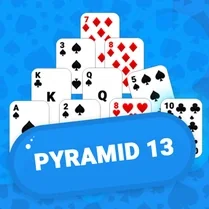 Pyramid 13
 Pyramid Solitaire
 Pyramid Solitaire Quest
 Solitaire Harvest
 Solitaire HD
 Solitaire: Heroes Evolution
 Solitaire Jazz Travel
 Solitaire Josephine and the Forty Thieves