Matchstick brain training
Matchstick brain training turns a tabletop classic into a series of tricky challenges. Each stage shows a simple arithmetic problem or figure built from wooden sticks, and your task is to make it correct or transform it into something new. Whether you shift one stick, add another, or remove one entirely, every decision counts. The puzzles start easy but quickly ramp up in difficulty, pulling you into a loop of trial, error, and satisfying breakthroughs. What sets this puzzler apart is its focus on spatial reasoning. You can't just crunch numbers—you need to see how changing one stick affects the whole layout. As you progress, the game becomes a mental workout that improves your problem-solving skills and your ability to spot hidden patterns. The clean, minimal presentation keeps you locked on the core mechanics, making it an easy pick for a quick brain teaser or a longer session of logical play.
 WaffleMath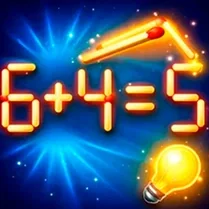
Common Core State Standards
Every game supports specific Common Core standards. Browse the full standards library.
Practice by Skill
Games by Grade
What is Matchstick brain training
Get ready to bend your logic skills out of shape. This puzzle game puts a new twist on the classic matchstick riddle, asking you to think sideways to solve each challenge.
How to Play
Click or tap a matchstick to select it, then place it in a new position on the board. You can also pick from options to add or remove sticks, depending on what the level requires.
Tips for Playing
- Always check the equation's structure before moving sticks; sometimes a single shift fixes everything.
- If you're stuck, try counting the matches in the current figure and the target shape to see what differs.
- Look for number patterns—sometimes converting a 6 to a 0 or a 9 is the key.
- Don't be afraid to experiment; every move can be undone, so test wild ideas.
- Save your logical reasoning for later levels; early puzzles are for warming up your eye.
Frequently Asked Questions
How many sticks can I move in a single puzzle?
The number of moves is shown on each level, and it varies. Some challenges ask for just one change, while others permit several, so always check the target.
Is there a time limit for each level?
There is no strict time limit, so you can take as long as you need to figure out the best move. The focus is on accuracy rather than speed.
Can I add new matchsticks to solve a puzzle?
Yes, some puzzles require adding sticks. The available actions—move, add, or remove—are indicated at the bottom of the screen for each level.
What happens if I make a wrong move?
You can undo any move, so a mistake isn't a dead end. Simply hit the undo button to revert to your previous state and try another approach.
Does the game have different difficulty levels?
The puzzles are arranged in a progressive order, starting with simple equations and moving to more complex spatial challenges. You'll naturally face harder tasks as you advance.
Can I replay a level once I finish it?
Yes, after completing a level, you can go back and replay it whenever you want. This is handy if you'd like to improve your moves or just enjoy the puzzle again.
Related Puzzle Games

 Boost Your Brain!
 Brain Training
 Brain Trainer
 Block Escape: Brain Training
 Brain trainers
 Disassemble Arrows: Upgrade Your Brain
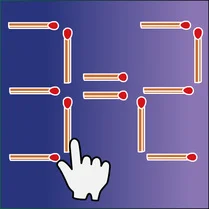 Move the match
 Matches Puzzle
 Multiplication Table Training
 Killer Sudoku
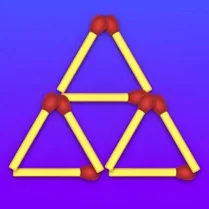 Matches - Test Your Logic
 Matchstick Puzzle
 A mathematical exercise with numbers for logic
 Mathematical-Numerical Crossword: Numbers
 Math matches
 Math Puzzles: Crosswords
 Math: Riddles
 Numbers - charging for the brain!