Numbers: 10 in a Row
Numbers: 10 in a Row takes the simple act of adding and turns it into a satisfying spatial challenge. On a compact grid, you'll find random digits scattered about. Your goal is to locate neighboring numbers—whether they sit side by side, stacked, or diagonally—that sum to ten. When you connect them, they vanish, earning you points and making room for the next batch of digits to drop in. It's a loop that's easy to grasp but surprisingly tricky to plan ahead for, as each move reshapes the board and opens new possibilities. The game's beauty lies in its balance of calculation and foresight. You're not just crunching numbers; you're spotting patterns and setting up chains that clear multiple sets in a single move. The minimalist visuals keep your focus sharp, while the subtle sound effects provide satisfying feedback without distraction. Whether you have a few minutes or a longer stretch, this title offers a refreshing mental workout that feels less like a chore and more like a playful exercise. Each session ends with a final score, giving you a clear reason to return and beat your personal best.
 WaffleMath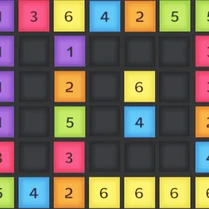
Common Core State Standards
Every game supports specific Common Core standards. Browse the full standards library.
Practice by Skill
Games by Grade
What is Numbers: 10 in a Row
Welcome to a puzzle that makes addition feel like a game of hide-and-seek. Spot the pairs that add to ten before the grid fills up.
How to Play
Tap or click on two adjacent numbers that add up to 10 to remove them from the board. Keep clearing space to prevent the grid from overflowing and to keep your score climbing.
Tips for Playing
- Look for pairs that are not directly beside each other—diagonal neighbors count too.
- Plan your moves ahead to create larger chains that clear multiple sets at once.
- Avoid getting tunnel vision on one area; scan the whole board for quick wins.
- When the grid gets crowded, prioritize the pairs that free up space for new numbers.
- Keep a mental note of which digits are plentiful to anticipate future combinations.
Frequently Asked Questions
What happens when the grid fills up completely?
If no more pairs can be formed and the grid is full, the game ends. Make sure to keep clearing space to stay in the game.
Can I undo a move if I make a mistake?
There's no undo feature, so every move counts. Think before you click to avoid getting stuck.
Is there a time limit in the game?
No, the game is turn-based. You can take as long as you need to spot the right pairs, so plan without pressure.
Do diagonal pairs count as adjacent?
Yes, diagonal neighbors are considered adjacent. This expands your options for finding sums of ten.
How is the final score calculated?
Each successful pair grants points, and clearing multiple pairs in quick succession may earn bonus points. Try to chain clears for a higher score.
Related Puzzle Games

 Master of Numbers
 Digit Shooter
 Growing numbers: Connect and Purify
 Merger: One Million
 Growing numbers
 The New Puzzle 2248
 Merge Squad: 2048
 Addition and Subtraction
 Binary trainer
 Connect: Merge Number Puzzle
 Digits (Numbers, seeds)
 Infinite Math
 King of Numbers - Puzzle Master
 MathCross: Math Crossword Puzzle
 Math Crossword. Number Puzzle
 Mathematical crossword
 Numbers 19
 Numbers 2244