Magic Cubes 2048
Magic Cubes 2048 takes the familiar number-merging mechanic and lifts it into three dimensions. Instead of swiping across a flat grid, you shift cubes along a 3D matrix, watching them tumble and stack. Each move nudges the entire field, so you must think about vertical alignment as much as horizontal rows. The added axis creates fresh strategic layers, turning every shift into a calculated risk about what will combine and what will clutter the board. Success hinges on careful placement and foresight. As numbers grow, the squeeze for space tightens, and one careless slide can leave a low-value cube stranded. The game rewards players who plan several moves ahead, keeping higher values in corners and nurturing smaller ones in the open. With its clean visuals and escalating difficulty, Magic Cubes 2048 offers a satisfying brain teaser that feels both familiar and strikingly new.
 WaffleMath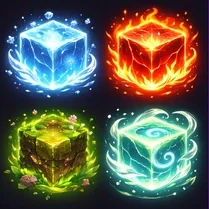
Common Core State Standards
Every game supports specific Common Core standards. Browse the full standards library.
Practice by Skill
Games by Grade
What is Magic Cubes 2048
Ready to test your spatial reasoning? Magic Cubes 2048 blends the addictive merge puzzle with a 3D twist, making every move a three-dimensional decision.
How to Play
Shift the entire cube field in one of four directions (up, down, left, right) to slide all cubes simultaneously. When two cubes with the same number collide, they merge into one with double the value—keep combining until you create the 2048 cube.
Tips for Playing
- Focus on keeping your highest-value cube in a corner to minimize disarray.
- Build numbers gradually along a single edge instead of spreading them out.
- Before each move, scan both rows and columns to predict vertical merges.
- Avoid moving in directions that isolate small cubes in hard-to-reach spots.
- If you see a 2 or 4 stuck behind larger values, plan a sequence to free it early.
Frequently Asked Questions
What happens when I make a move that causes multiple merges?
All possible merges happen simultaneously in one cascade. Cubes combine in order, so you might chain several merges in a single move.
Can I undo a move?
The standard game does not include an undo feature. You'll need to live with each decision, so think ahead!
What's the best strategy for beginners?
Keep your largest cube in a corner and always slide toward that corner. Try to build a chain of lower numbers that feed into it.
Is there a score limit?
No, your score increases with each merge, and you can keep playing beyond 2048 to chase even higher values like 4096 or 8192.
What if I run out of moves?
The game ends when no more merges are possible. You can restart and try a different approach to avoid dead ends.
Does the 3D grid make the game much harder?
Yes, the extra dimension adds complexity because you must consider vertical lines, making spatial awareness more crucial than in the 2D version.
Related Match Bubble Games
 Number Match
 21 Cards
 Connect: Merge Number Puzzle
 Drop Merge 2048
 Dropping Merge 2048
 Find the Numbers from 1 to 99!
 Mania Sudoku
 Number Games: Number Match
 Number Match - Classic number game
 Schulte Table PRO
 Traffic Escape
 2048
2048 8-8 Puzzle Block Master
 Block Puzzle: Neon Adventure
 Cubes 2048.io
 2048 Legend
 Ball Run 2048: merge number
 Bingo
Bingo