Football Orbit
Football Orbit swaps the turf for the void. Instead of a pitch and goalposts, you're steering a lone soccer ball through the silent, star-dusted expanse of space, where the physics of orbit dictate every twist and turn. The challenge isn't just about kicking — it's about reading the invisible lines of gravitational pull that curve your path, letting you slingshot around planetoids and dodge drifting space rocks that threaten to knock you off course. Each level presents a fresh puzzle of trajectories and floating goal markers that demand careful planning and a steady hand. What makes Football Orbit stand out is how it transforms a simple sport into a test of spatial reasoning. The absence of gravity means your ball never falls; it glides, loops, and spirals according to the momentum you give it. Success comes from mastering the art of timing your boosts and aligning your approach with the rotation of the celestial bodies around you. It's a quiet, thoughtful experience that rewards patience and precision over raw speed, appealing to players who enjoy a more contemplative arcade challenge.
 WaffleMath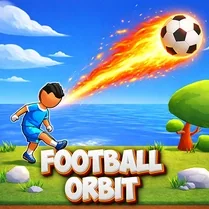
Common Core State Standards
Every game supports specific Common Core standards. Browse the full standards library.
Practice by Skill
Games by Grade
What is Football Orbit
Football Orbit takes the beautiful game to outer space, where gravity is just a suggestion and goals float among the stars. Master the pull of planets and the drift of debris to score in this one-of-kind orbital adventure.
How to Play
Control your football's direction and power with the mouse or touch, aiming to navigate through asteroid fields and into glowing target rings. Tap or click to boost your momentum, using the gravitational pull of nearby planets to curve your trajectory toward the goal.
Tips for Playing
- Observe each planet's gravitational field and plan your route to use its pull as a slingshot.
- Time your boosts early — momentum changes take a moment to take effect in space.
- Aim for the center of the goal ring; grazing the edge may cause an unpredictable rebound.
- When the path looks blocked, look for a planet's shadow — it might hide a safe passage.
- Patience is a virtue: a slow, calculated drift often beats a hasty dash through the debris.
- Study the pattern of moving obstacles for a few seconds before making your move.
Frequently Asked Questions
Is Football Orbit a multiplayer game?
No, it's a single-player puzzle experience. Each level is an independent challenge focused on your timing and skill.
What are the controls?
You control the ball with your mouse or finger, clicking/tapping to add thrust. The direction of your movement depends on where you aim relative to the ball.
How does zero-gravity affect gameplay?
Since there's no gravity pulling the ball down, it moves in straight lines or curved paths based on whatever forces you apply and the pull of nearby planets. This means you'll need to plan your shots with more care.
Are there different types of objectives?
Yes, the primary objective is always to guide your football into the goal ring, but some levels may have additional requirements like collecting stars or passing through multiple rings in sequence.
What happens if I hit an asteroid?
Crashing into an asteroid typically ends the level, causing you to restart from the beginning. Some larger obstacles may just push you off course, but it's best to avoid contact altogether.
Can I stop my ball's movement once it's in motion?
You have limited control over stopping the ball. You can apply reverse thrust to slow down, but often it's easier to redirect momentum than to come to a complete halt.