Classic Solitaire Free Cell
Classic Solitaire Free Cell delivers a pure, logic-driven card challenge that rewards foresight over luck. The entire deck is dealt face-up across eight columns, and your objective is to shift every card, suit by suit, onto the four foundation piles beginning with aces. What makes this variant stand out is the absence of a draw pile—every decision you make shapes the puzzle, and a single misstep can lock the board. To succeed, you rely on the four free cells as mobile holding slots, allowing you to temporarily park cards while you uncover and rearrange the columns. Successive cards must be placed in descending order with alternating colors on the tableau, while foundations accept ascending runs of a single suit. This is a game of meticulous planning and patience, where the player's ability to visualize multiple steps ahead often spells the difference between a finished board and a deadlock.
 WaffleMath
Common Core State Standards
Every game supports specific Common Core standards. Browse the full standards library.
Practice by Skill
Games by Grade
What is Classic Solitaire Free Cell
Classic Solitaire Free Cell is a brain-teasing patience game that turns a standard deck into a battlefield of strategy and order. Every move counts, and the absence of a draw pile means you either outsmart the layout or restart with fresh cards.
How to Play
Click on a card to select it, then click on a destination: a foundation slot, a tableau column with a matching card, or an empty free cell. Move cards in descending order with alternating colors to expose new ones, and build aces through kings in each suit on the foundations.
Tips for Playing
- Aim to free up aces and deuces early so you can start building foundations without cluttering your tableau.
- Use empty free cells as temporary parking spots for high cards that block important moves, but keep them as available as possible.
- Prioritize uncovering face-down cards in the tableau—each hidden card is a step toward breaking a deadlock.
- Never move a card to a foundation unless you are certain it won't be needed later, as retrieving it can be very costly.
- Try to create an empty tableau column early; it serves as a powerful wild-card space for moving entire sequences.
Frequently Asked Questions
Can I undo a move if I make a mistake?
Yes, most versions offer an undo button that lets you step back one move at a time. Use it to recover from an accidental placement or to test different strategies.
How many cards are in the free cells?
There are exactly four free cells at the top of the screen. They can hold one card each, providing temporary storage to help rearrange the tableau.
What happens if I get stuck?
If no legal moves remain and you've cleared all possible avenues, the game is effectively over. You can restart with a new random shuffle and try a different approach.
Are all deals winnable?
Not necessarily. While Free Cell is designed to be winnable most of the time, some random deals are impossible to solve regardless of strategy. Don't get discouraged—just shuffle again.
Can I move a sequence of multiple cards at once?
You can move only a single card at a time to a free cell or another tableau column, unless an entire column is empty. A sequence can be moved as a group only when there's an empty column to receive it.
Is there a time limit?
No, Classic Solitaire Free Cell is a turn-based game with no clock pressure. You can take as long as you need to study the board and plan your next move.
Related Card Board Games

 3 Peaks Solitaire
 Classic Solitaire: FreeCell
 Desire Solitaire
 Epic Solitaire «Athena»
 Epic Solitaire «FreeCell»
 Freecell 2025
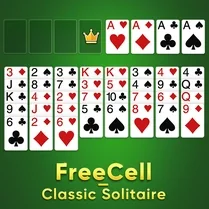 FreeCell - Classic Solitaire
 FreeCell solitaire
 FreeCell Solitaire 2024
 Gaps Solitaire
 Gaps Solitaire 2026
 Golf Solitaire
 Lay out the cards: Scorpio Solitaire
 Lay out the cards: Solitaire Alternation
 Lay out the cards: Solitaire Carpet
 Lay out the cards: Spider Solitaire
 Solitaire Freecell
 Solitaire FreeCell Classic